How to Thaw a Frozen Pipe Safely, and What to Do in the First Hour If a Pipe Bursts in Your Home
A faucet that only trickles on a bitter morning is a warning, not a disaster yet. Here is how to thaw the line safely and what to do, step by step, if it has already split.
Key takeaways
- Low or no water from one faucet during a hard freeze usually means a frozen pipe. Open that faucet before you start warming the line.
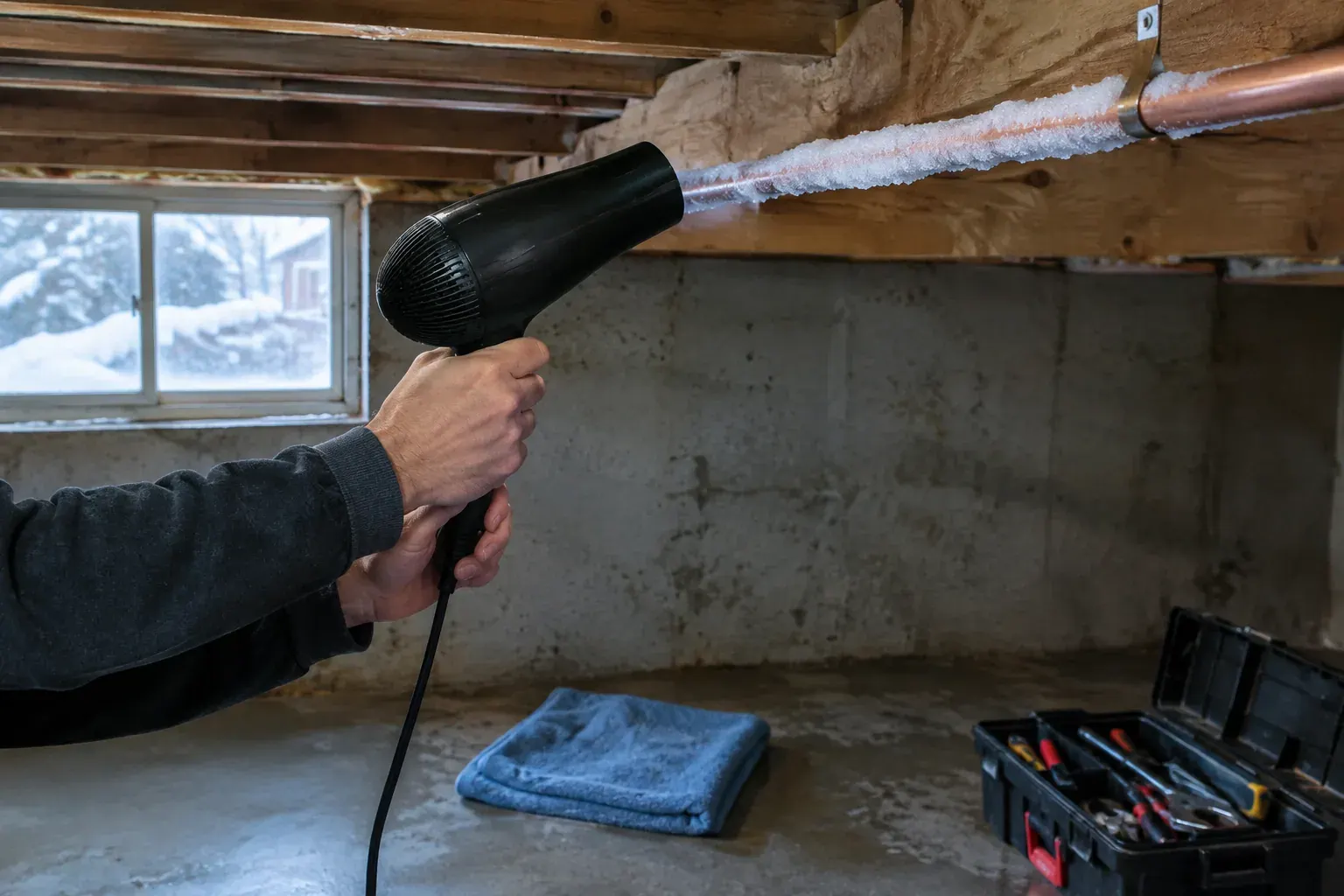
- Use gentle heat such as a hair dryer, heating pad or warm towels, working from the faucet back toward the frozen spot. Never use an open flame.
- If a pipe bursts, close the main water shutoff first, then deal with electricity, then start removing water.
- Photograph everything before cleanup and call your insurer quickly. Most policies expect you to take reasonable steps to limit further damage.
- Wet materials should be drying within 24 to 48 hours to reduce the risk of mold, so call a water mitigation company early for large leaks.
In this guide
- How to Tell If a Pipe Is Frozen
- Find the Frozen Section Before You Add Heat
- How to Thaw a Frozen Pipe Safely
- What to Do in the First Hour If a Pipe Bursts
- Document the Damage and Call Your Insurer
- Dry Out Fast and Know What It May Cost
- Keep It From Happening Again This Winter
- Common Mistakes to Avoid
- When to Call a Professional
- The Bottom Line
You turn on the kitchen faucet on the coldest morning of the year and get a thin trickle, or nothing at all, while the bathroom sink works fine. That is the classic sign of a frozen pipe, and what you do in the next hour decides whether it ends as a minor annoyance or a ceiling full of water.
This guide covers both situations: a pipe that is frozen but still intact, and one that has already split. You will find how to locate the frozen section, the safe ways to thaw it, what to do step by step if water starts pouring out, how insurance usually treats the damage and when the job belongs to a plumber. If you are getting your house ready before cold weather arrives, our fall home maintenance checklist covers prevention.
How to Tell If a Pipe Is Frozen
Pipes are most likely to freeze during a deep cold snap, especially when overnight temperatures fall to around 20 degrees F or below for several hours. Homes in the South are often hit hardest during rare freezes, because plumbing there may run through attics, exterior walls and uninsulated crawl spaces.
Common signs include:
- One faucet gives little or no water while others work normally.
- Frost on an exposed pipe, often in a basement, garage or under a sink on an outside wall.
- A toilet that does not refill after flushing.
- Strange sounds such as gurgling or banging when you open a tap.
- A bulge or a hairline crack in the pipe, which means the pipe may already be damaged.
If no faucet in the house works, the freeze may be at the main line where it enters the home, at the water meter, or in the utility’s service line. If you are on city water, check with neighbors and call your water utility before you assume the problem is inside.
Find the Frozen Section Before You Add Heat
Start at the faucet that is not working and follow the pipe back toward where water enters the house. The frozen spot is usually where the pipe passes through the coldest area: an exterior wall, an unheated garage, a crawl space, an attic or a cabinet on an outside wall.
Feel along the pipe, which is often noticeably colder at the blockage, and look for frost. An inexpensive infrared thermometer makes this easier because you can scan along a pipe and see where the temperature drops.
Before you warm anything, look closely for splits, bulges or wet spots. If the pipe is already cracked, close the main water shutoff before you thaw it. Otherwise the ice that was plugging the crack melts and water starts spraying as soon as the line clears.
How to Thaw a Frozen Pipe Safely
Once you have found the frozen section and checked it for damage, the method is simple: open the faucet, apply gentle heat, and be patient.
- Open the faucet the pipe feeds, both hot and cold if it is a mixing faucet. As the ice melts, water needs somewhere to go, and running water helps melt the rest of the blockage.
- Start warming the pipe near the faucet and work back toward the frozen area. Thawing from the open end lets water and steam escape instead of building pressure behind the ice.
- Keep the heat steady until full water pressure returns, then let the water run for a few minutes.
- Check the other faucets in the house. If one pipe froze, others in similar spots may be close behind.
- Inspect the pipe and the area around it for drips over the next few hours, because small cracks sometimes show up only after the line is under pressure again.
Safe heat sources, compared
| Method | Best for | Watch out for |
|---|---|---|
| Hair dryer | Exposed pipes under sinks, in basements | Keep it away from standing water and do not leave it running unattended |
| Electric heating pad | A short exposed section you can wrap | Use a pad designed for this kind of use and follow its directions |
| Towels soaked in hot water | Any exposed pipe, including plastic | Slow; replace the towels as they cool and protect the floor |
| Portable space heater | Warming a whole cabinet, closet or small room | Keep at least 3 feet from anything that can burn, never leave it running unattended |
| Opening cabinet doors and raising the thermostat | Pipes inside walls you cannot reach | Can take hours, and may not work on very cold exterior walls |
| Self-regulating heat cable | Pipes that freeze every winter | Install before the freeze, follow the manufacturer’s instructions, and use a listed product |
Plastic pipes such as PEX and CPVC need gentler treatment than copper. Use the low setting of a hair dryer or warm towels, and keep heat moving. PEX tolerates freezing better than rigid pipe, but its fittings can still fail, and CPVC becomes brittle in the cold.
Safety note: Never use a propane torch, blowtorch, kerosene or propane heater, charcoal grill or any open flame to thaw a pipe. Flames can ignite framing and insulation inside walls, damage the pipe and, with fuel-burning heaters indoors, produce carbon monoxide. Keep electrical devices away from water, and if water is already leaking near a hair dryer or heater, unplug it before you touch anything else.
When the frozen pipe is inside a wall or ceiling
If the pipe is behind drywall, raise the thermostat a few degrees, open sink cabinets so warm room air can reach the plumbing, and run a space heater safely in the room. Do not cut into a wall unless you know what else runs through it. A plumber can open the wall, thaw or replace the section, and add insulation while it is accessible.
What to Do in the First Hour If a Pipe Bursts
A burst pipe can release a great deal of water in a short time, so the order of your first moves matters more than speed alone.
- Close the main water shutoff. It is usually where the water line enters the house: in a basement near the front wall, in a crawl space, in a utility closet or near the water heater. In warm climates it is often in the garage or on an outside wall. A round handle turns clockwise to close; a lever handle turns a quarter turn so it sits across the pipe.
- If you cannot find or turn the main valve, call your water utility’s emergency line. Many homes also have a curb stop in a box near the street, which may need a special meter key, and some utilities restrict who may operate it.
- Deal with electricity before you walk into water. If water is near outlets, appliances or the electrical panel, do not step into it. Shut off power to the affected circuits only if you can reach the panel while standing on a dry surface. If you cannot, call your electric utility or an electrician.
- Open the faucets on the lowest level to drain water still in the pipes, and flush toilets to empty their tanks.
- Turn off the water heater according to its instructions (the power for an electric model, or the setting the manufacturer recommends for a gas model). This protects it if the system will be drained or left off for a while.
- Start moving water and belongings. Lift furniture onto blocks or foil, move rugs, electronics and papers to a dry area, and use a wet vacuum, mops and towels on standing water.
- Call a plumber, and if the leak soaked floors, ceilings or carpet, call a water mitigation company as well.
Pro tip: Find your main water shutoff today, before anything goes wrong. Clear the space around it, test that it turns, and tag it so everyone in the household can find it in the dark. If it is stuck or corroded, have a plumber replace it while it is not an emergency.
Water coming through a ceiling
If a ceiling is sagging or bulging with trapped water, keep everyone out from under it. A sagging section can drop suddenly and bring heavy, wet drywall down. Professionals sometimes release the water in a controlled way with buckets ready, but do not do it if the bulge is large, near a light fixture or you are unsure what is above it.
Document the Damage and Call Your Insurer
Before you throw anything away or start major cleanup, take photos and video of every affected room, the burst pipe, the water level and damaged belongings. Keep the broken section of pipe if the plumber replaces it, and save every receipt, from towels and fans to hotel nights if you have to leave.
Then report the claim promptly. Most homeowners policies require you to take reasonable steps to prevent further damage, so stopping the water and starting to dry the home is part of protecting your claim, not something to delay until an adjuster arrives.
What policies typically treat differently:
- Usually covered: sudden and accidental water damage from a pipe that freezes and bursts, such as ruined drywall, flooring and belongings.
- Often excluded: slow leaks that went on for weeks, wear and tear, and freezing damage in a home that was left unheated without reasonable care, for example a vacant property where the heat was turned off and the water was not shut off and drained.
- Varies: the cost of the pipe repair itself, mold remediation limits, and additional living expenses if you have to move out.
Renters should notify the landlord right away and follow up in writing. Condo owners should call both the association and their own insurer, because the master policy and the unit owner’s policy usually split responsibility.
Dry Out Fast and Know What It May Cost
Mold can begin to grow on damp materials within 24 to 48 hours, so drying needs to start the same day. Run fans and a dehumidifier and pull up wet rugs; wet carpet pad usually has to be replaced. Drywall can look fine while staying wet inside, which is why mitigation companies use moisture meters and often cut away the lower part of soaked walls.
Costs vary widely with region, the time of day and how much water escaped. As a rough guide:
| Job | Typical range | What drives the price |
|---|---|---|
| Plumber thawing an accessible pipe | About $150 to $500 | Access, emergency or after-hours rates |
| Repairing a short burst section | About $200 to $1,000 | Pipe material, location, opening and closing walls |
| Professional water mitigation and drying | About $1,000 to $5,000 or more | Square footage, number of rooms, days of equipment |
| Drywall, flooring and finish repairs | Often several thousand dollars | Materials removed, ceilings, flooring type |
A burst pipe is one of the most common reasons homeowners dip into savings for a deductible. If that would be hard right now, our guide to building an emergency fund on a tight budget can help you plan for the next surprise.
Keep It From Happening Again This Winter
Once the pipe is thawed or repaired, protect it for the rest of the cold spell:
- Keep the thermostat at the same temperature day and night during a freeze, rather than turning it down at bedtime.
- If you travel, leave the heat on, commonly no lower than 55 degrees F, and ask someone to check the house. For longer absences, ask a plumber about shutting off the main and draining the lines.
- Open cabinet doors under sinks on exterior walls so room air can reach the pipes.
- Let a slow drip run from faucets on vulnerable lines when temperatures are forecast to plunge.
- Keep the garage door closed if water lines run through the garage.
- Seal drafts near pipes and add foam pipe insulation to exposed runs.
Good to know: If the same pipe has frozen before, it is likely to freeze again. Ask a plumber whether it can be rerouted into a heated space, better insulated or protected with a self-regulating heat cable.
Common Mistakes to Avoid
- Thawing a cracked pipe with the water still on. Check for damage first, and close the main if you see a split.
- Using an open flame. Torches and fuel-burning heaters cause house fires and carbon monoxide poisoning every winter.
- Closing the faucet while thawing. An open faucet relieves pressure and shows you when the line clears.
- Walking into standing water near outlets or appliances. Deal with the power first, or call for help.
- Throwing out damaged items before photographing them. Insurers need proof of what was lost.
- Waiting days to dry out. Wet drywall, insulation and carpet pad can grow mold quickly, and a delay can complicate a claim.
- Turning the heat down to save money during a hard freeze. The savings are small compared with the cost of a single burst pipe.
When to Call a Professional
Call a licensed plumber if you cannot find the frozen section, the pipe is inside a wall, ceiling or crawl space you cannot reach safely, you see a crack or bulge, no water is coming into the house at all, or a thawed pipe starts leaking. Call a water mitigation company for anything more than a small puddle, especially if water reached ceilings, walls or flooring. For electrical concerns, call an electrician or your electric utility, and for a shutoff you cannot operate, call your water utility.
The Bottom Line
A frozen pipe that has not split is usually a fixable morning problem: open the faucet, warm the line gently from the open end, and never use a flame. Check for cracks before you thaw, and keep an eye on the area for a few hours afterward.
If a pipe has burst, close the main water shutoff first, stay away from water near electricity, then document, report and dry. Knowing where your shutoff is before the next cold snap is the single step that saves the most money and stress.
Frequently asked questions
How long does it take for a frozen pipe to thaw?
With steady, gentle heat on an exposed pipe, a short frozen section often clears in 30 minutes to an hour. A long section, a pipe inside an exterior wall or a line in a crawl space can take several hours, or may not thaw at all until the weather warms. If you have made no progress after an hour or so, or you cannot reach the frozen area, call a plumber.
Will a frozen pipe thaw on its own?
It usually will once temperatures rise, but waiting is risky. Ice keeps building pressure between the blockage and the closed faucet, and many pipes split while frozen and only start leaking when they thaw. Thawing the line under control, with the faucet open and someone watching, lets you catch a leak right away.
Does homeowners insurance cover a burst pipe?
Many standard homeowners policies cover sudden and accidental water damage from a burst pipe, while excluding slow leaks, wear and tear and damage that results from not keeping the home heated. Coverage for the pipe repair itself varies. Read your policy's water damage section and ask your agent or insurer what applies to your situation.
I rent. Who pays when a pipe bursts in my apartment?
The landlord is generally responsible for repairing the plumbing and the building, and the landlord's policy usually covers the structure. Your own belongings are typically covered only by a renters insurance policy. Notify the landlord immediately, follow up in writing, and photograph your damaged property before anything is thrown away.
Should I keep a faucet dripping after I thaw a pipe?
During the rest of a cold snap, a slow drip from the faucet on a vulnerable line can help, because moving water is harder to freeze and an open faucet relieves pressure. Combine it with other steps such as opening cabinet doors and keeping the thermostat steady, and follow any guidance from your water utility.