Moon Rituals and Traditions: A Guide for Moon Enthusiasts
From the new moon to the full moon, lunar traditions offer ways to mark time and pay attention to the night sky. Learn what the phases mean and how to observe them thoughtfully.
Key takeaways
- The moon’s phases repeat in a cycle of about 29.5 days, from new moon to new moon.
- Popular North American full moon names vary by source and are not universal Indigenous names.
- Lunar festivals reflect distinct cultures, calendars, and local traditions, even when they share a moon phase.
- A simple moon ritual can be a quiet moment to reflect, without treating lunar beliefs as proven effects.
- Clear skies, a safe viewing spot, and a steady camera matter more than expensive equipment.
In this guide
The moon can be a familiar sight and still feel different from one night to the next. If you want to understand its phases, learn about the names and festivals associated with it, or start a personal moon-watching practice, a little context will help you do so with care.
This guide explains the lunar cycle, describes common full moon names used in North America, and introduces lunar festivals from several cultures. You’ll also find practical ideas for a simple ritual, watching the moon in the United States, and photographing it without specialized gear.
The moon’s phases, in plain English
The moon does not make its own light. Sunlight illuminates part of it, and as the moon moves around Earth, we see different portions of that sunlit half. The repeating cycle from one new moon to the next takes about 29.5 days.
The phase names describe how the moon looks from Earth, not a change in the moon itself. The basic sequence is:
- New moon: The moon is roughly between Earth and the sun, so its lit side faces mostly away from us. It is usually difficult to see.
- Waxing crescent: A slim illuminated curve appears and grows. “Waxing” means the visible lit portion is increasing.
- First quarter: About half the moon’s visible disk is lit. It is called first quarter because the moon has completed roughly a quarter of its orbit since new moon.
- Waxing gibbous: More than half is lit, and the bright area continues to grow.
- Full moon: Earth is roughly between the sun and moon, and the moon’s visible face appears fully illuminated. The alignment does not happen perfectly every month, which is why most full moons do not cause an eclipse.
- Waning gibbous: The visible lit portion begins to shrink after full moon.
- Third quarter: About half the disk is lit again, on the opposite side from first quarter.
- Waning crescent: A narrowing curve remains before the next new moon.
The phase tells you more than appearance. A young crescent is often visible soon after sunset, while a full moon rises around sunset and sets around sunrise. The moon rises later on successive days, but the exact time depends on its phase and your location.
Good to know: “Quarter moon” refers to the moon’s place in its cycle, not to a quarter of its surface being illuminated. From Earth, a quarter moon looks about half lit.
Common North American full moon names
Many US calendars and almanacs use a set of monthly full moon names, including Wolf Moon, Strawberry Moon, and Harvest Moon. These names are useful cultural references, but they are not official astronomical terms, and they do not represent one naming system shared by all Native nations.
Some names have Indigenous roots, while others reflect European, colonial, or later almanac traditions. A name’s meaning and use can differ by community and region. The table below shows a familiar set of names often published in the United States, not a definitive account of every tradition.
| Month | Commonly listed name | Context often associated with the name |
|---|---|---|
| January | Wolf Moon | Winter and wolf calls in some traditional accounts |
| February | Snow Moon | Snowy conditions in parts of North America |
| March | Worm Moon | Thawing ground and signs of spring in some regions |
| April | Pink Moon | Early spring flowers, not a pink-colored moon |
| May | Flower Moon | Spring blooms |
| June | Strawberry Moon | The strawberry harvest in some communities |
| July | Buck Moon | The season when young male deer grow antlers |
| August | Sturgeon Moon | Sturgeon fishing in parts of the Great Lakes region |
| September | Harvest Moon | The full moon closest to the autumnal equinox, though it can fall in October |
| October | Hunter’s Moon | A name associated in some accounts with autumn hunting and preparation for winter |
| November | Beaver Moon | Accounts connect the name with beaver trapping or preparation for winter |
| December | Cold Moon | The cold and long nights of winter |
A named full moon is not necessarily the only full moon in that month, and names can shift between calendars and sources. The Harvest Moon is the key exception to a fixed monthly label: it is defined by its relationship to the autumnal equinox, so it can occur in September or October.
If you are sharing a name from a specific Native community, look for that community’s own explanation rather than presenting a general almanac list as universal. You can also enjoy the moon without assigning it a name.
Lunar festivals around the world
The moon is part of many calendars and celebrations, but similar timing does not mean that traditions are interchangeable. A lunar or lunisolar calendar uses the moon’s cycle to mark months; a lunisolar calendar also keeps its year aligned with the seasons. Communities may observe the same phase in very different ways.
Lunar New Year is a broad term for New Year observances tied to lunar or lunisolar calendars. Chinese Spring Festival, Korean Seollal, and Vietnamese Tết are distinct celebrations with their own customs, foods, family practices, and histories. They generally begin around a new moon in late January or February, but the exact date changes each year. Calling them all “Chinese New Year” erases that diversity.
The Mid-Autumn Festival, celebrated in several East and Southeast Asian communities, falls on the 15th day of the eighth lunar month, near the full moon. In China and other places, mooncakes and family gatherings are common, while customs vary by region. Vietnam’s Tết Trung Thu is also associated with this time and has its own traditions, including lanterns and celebrations for children.
In Japan, Tsukimi, or moon viewing, is an autumn tradition of appreciating the harvest moon. Offerings such as rice dumplings and seasonal grasses are associated with some observances. In Thailand, Loy Krathong takes place around the full moon of the 12th Thai lunar month; local practices vary, and celebrations may involve floating decorated baskets. Some communities also hold Yi Peng lantern events around this period, though it is a distinct tradition and local rules matter.
Vesak, an important Buddhist observance in many countries, commemorates events in the life of the Buddha. Its date and practices vary among Buddhist traditions and calendars, and it is often associated with a full moon. For broader seasonal context, see Winter Solstice Traditions: How Cultures Celebrate the Longest Night.
Good to know: A festival’s date, meaning, and customs can differ across regions and communities. If you attend a public celebration, follow local guidance and learn what the event means to its hosts rather than assuming every observance follows the same script.
Make a simple, personal moon ritual
A modern moon ritual can be as simple as choosing a quiet moment to notice the sky and reflect. There is no single required method, and lunar rituals should be understood as personal or cultural practices, not as proven ways to predict events or control outcomes.
Try this low-key routine:
- Pick a phase or date. You might check in at the new moon, full moon, or once a week. A calendar can help you plan, but it is fine if clouds change your plans.
- Choose a comfortable place. A porch, backyard, park, or window with a view can work. Dress for the weather and make sure the spot is safe after dark.
- Set a small intention. Write down one thing you want to notice, appreciate, or work on. Keep it realistic, such as making time for a creative project.
- Spend a few minutes observing. Notice the moon’s shape, its position, the temperature, and other sounds. You can sit quietly, sketch, or take a short walk.
- Close with a note. Record the date, phase, weather, and one thought. Over time, your notes can become a personal record of the seasons.
You do not need special tools, paid services, or a particular belief system. If you borrow a practice from a living culture or religious tradition, learn its context and avoid presenting it as your own custom. If a reflective routine helps you settle, it may pair well with other approaches such as Sound Meditation: How to Practice With Singing Bowls, Gongs and Calming Sounds.
How to watch the moon in the United States
You can see the moon from a city, but darker surroundings make its shape and nearby stars easier to appreciate. The best viewing spot is one you can reach safely and legally. Check local park hours, access rules, and weather before heading out, especially if you plan to watch from a beach, trail, or public land after dark.
A few practical steps make a viewing session more rewarding:
- Check the phase and rise time. A local newspaper, astronomy calendar, planetarium, or reputable sky-watching app can help you plan. Times depend on your location, so use a forecast for your area.
- Look near the horizon for the moonrise. The moon can appear especially large near buildings or trees, but this is a visual effect, not a physical change in its size. A clear eastern view is useful around moonrise.
- Bring a layer and a dim light. Conditions can feel colder after sunset. A red-light setting can help preserve night vision, but use a regular flashlight when needed to walk safely.
- Give your eyes a moment. Avoid staring at bright phone screens between observations. Binoculars can show craters near the terminator, the boundary between lunar day and night.
- Consider the season and region. Cloud cover, humidity, wildfire smoke, and local light pollution all affect visibility. In Alaska and other far-northern areas, seasonal daylight can change when the moon is visible; coastal and mountain conditions can also shift quickly.
A full moon is easy to spot, but a crescent or quarter moon can make surface features stand out more clearly through binoculars because shadows are longer. Never point binoculars or a telescope at the sun. Looking at the moon with the unaided eye is safe, but viewing a solar eclipse requires proper, certified eclipse viewers except during the brief total phase of a total solar eclipse, and only for observers in the path of totality.
Photograph the moon with the gear you have
The moon is brighter than a typical night scene, so a camera’s automatic night setting may turn it into a featureless white disk. A tripod helps, but you can start with a phone or a camera and make adjustments after a test shot.
For a camera with manual controls, try a starting exposure around 1/125 second, f/8, and ISO 100 when photographing the bright moon by itself. These are starting points, not fixed rules. Adjust exposure if the surface looks washed out, and use a longer lens or optical zoom to make the moon larger in the frame. A remote shutter or a short timer can reduce blur from pressing the button.
For a phone, brace it against a stable surface or use a small tripod. Tap the moon on screen, lower the exposure if the bright disk loses detail, and avoid heavy digital zoom. If your phone offers a manual mode, reduce the exposure and keep the camera steady. A few test images are usually more useful than changing many settings at once.
For a landscape image, include a foreground element such as a tree line, building, or ridge. The moon can look small in a wide-angle photo, so plan the composition and use a longer focal length if you want it to appear prominent. For more on composing animal and outdoor images, see Wildlife Photography Tips: How to Capture Captivating Animal Images.
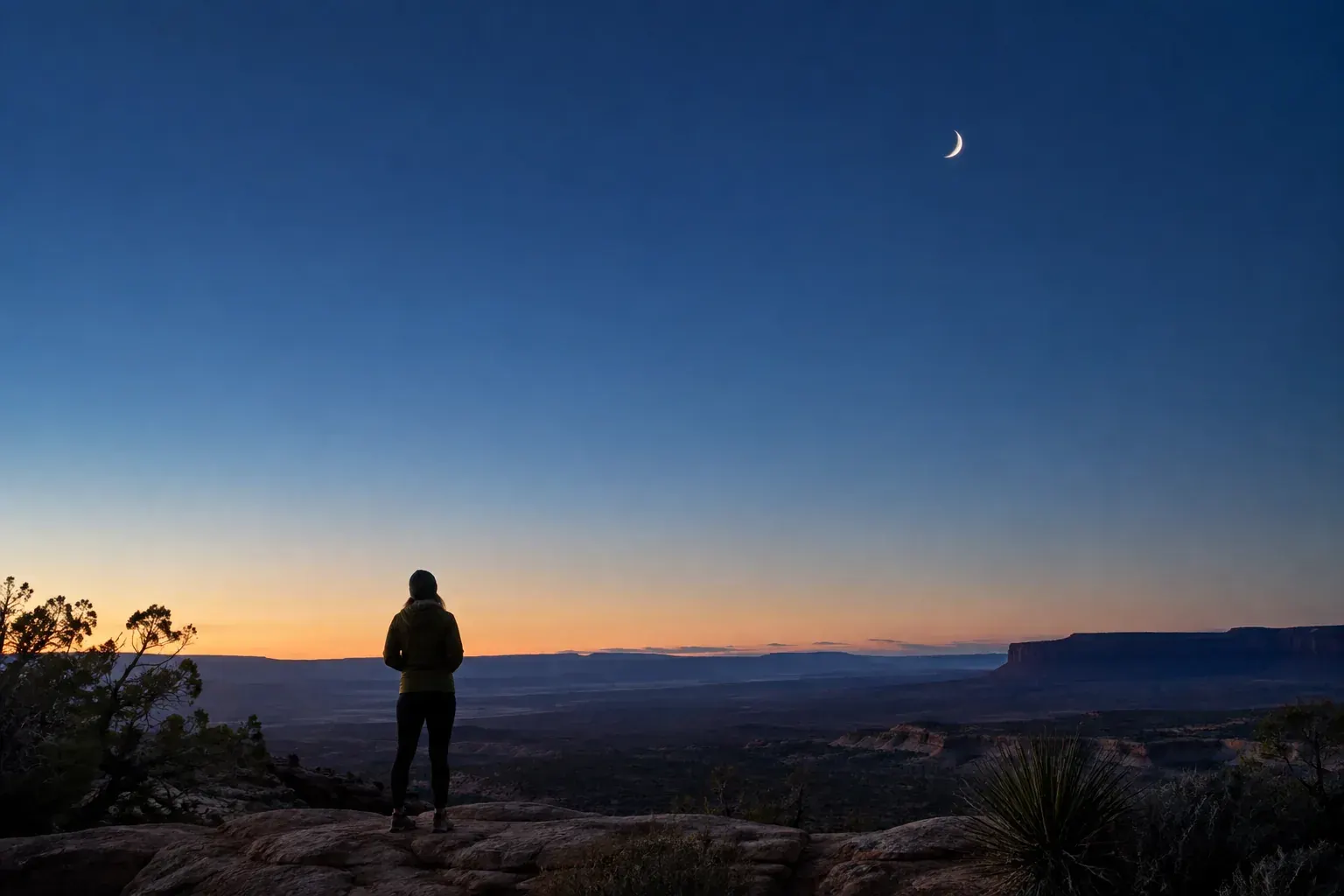
Pro tip: Photograph a crescent during blue hour, shortly after sunset. The sky may still have color, and the moon’s dimmer appearance can be easier to balance with the landscape than a bright full moon against a dark sky.
Common mistakes to avoid
- Treating every moon name as universal. Monthly lists are popular references, not a single system used by all Native communities or cultures.
- Confusing a festival with a phase. The full moon may shape a festival date, but the celebration’s meaning comes from its cultural and religious context.
- Expecting the moon to look dramatic every night. Clouds, haze, and light pollution affect what you see. A thin crescent can be subtle, and a full moon can wash out faint stars.
- Using a phone’s automatic night mode for a close moon shot. It may brighten the sky and overexpose the moon. Lower the exposure and take a few test frames.
- Taking risks for a better view. Do not trespass, drive while looking at the sky, or walk in unfamiliar dark areas without a light. Follow park and event rules, and leave lantern releases to permitted, organized events where they are allowed.
- Assuming a ritual guarantees a result. A reflective practice can help you set aside time or organize your thoughts, but it is not a substitute for medical care, financial advice, or other qualified help.
The Bottom Line
Learning the phases gives you a practical way to follow the moon, while names and festivals show how different communities have marked lunar time. Treat popular full moon names as one set of references, and approach cultural traditions with curiosity and respect.
For your own practice, start with a safe viewing spot, a date you can remember, and a few minutes of observation. You do not need perfect weather or special equipment to make the night sky worth noticing.
Frequently asked questions
How long does it take the moon to go through all its phases?
The cycle from one new moon to the next takes about 29.5 days. The familiar phase names describe the changing portion of the moon’s sunlit side that we see from Earth.
Are full moon names the same in every Native American culture?
No. Native nations have distinct languages, knowledge, and seasonal traditions, and there is no single naming system shared by all of them. Popular US almanac lists combine names with varied histories and should not be treated as universal Indigenous names.
What is the difference between Lunar New Year and the Mid-Autumn Festival?
Lunar New Year is a broad label for New Year celebrations tied to lunar or lunisolar calendars, including distinct observances such as Seollal and Tết. The Mid-Autumn Festival occurs on the 15th day of the eighth lunar month and is associated with the autumn full moon in several East and Southeast Asian communities.
When is the best time to see the moon?
It depends on what you want to see. A full moon is easy to find, while the shadows near the terminator during crescent and quarter phases can make surface features more visible through binoculars.
Can you photograph the moon with a phone?
Yes. Stabilize the phone, tap the moon, lower the exposure if its surface looks white, and avoid excessive digital zoom. A phone may capture the moon as a small disk, so include a foreground feature or use a camera with optical zoom for a larger image.